






FREE PUDO LOCKER DELIVERY!
Key Features
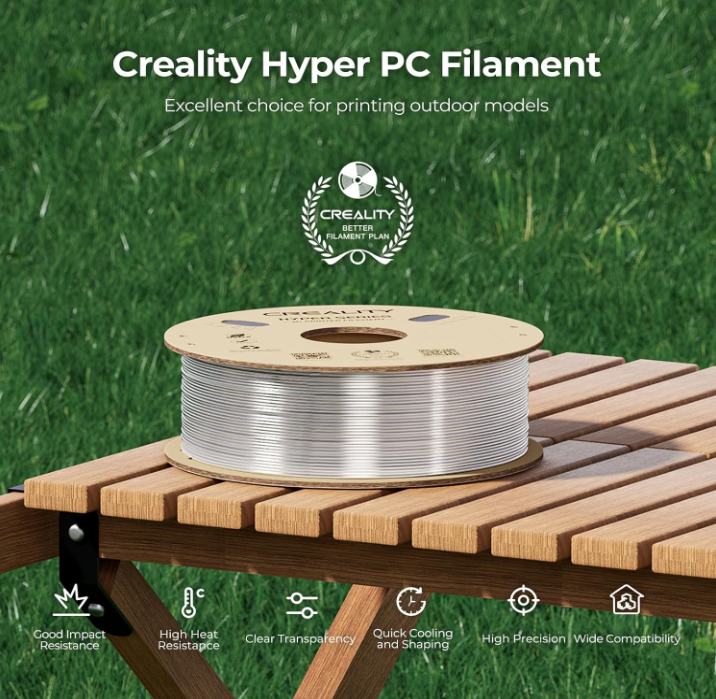
- High-performance polycarbonate filament
- High mechanical strength
- Excellent toughness
- Excellent impact resistance
- High heat resistance
- Suitable for demanding functional parts
- Transparent appearance
- Excellent for engineering prototypes
- Suitable for mechanical components
- Good dimensional stability
- 1.75mm filament diameter
- 1kg net filament weight
- Designed for suitably equipped FDM/FFF printers
- Genuine Creality filament
High-Strength Engineering Material
Hyper PC is designed for applications where mechanical performance matters.
Compared with everyday materials such as PLA, polycarbonate is better suited to components that need to withstand mechanical loads, repeated handling and demanding operating conditions.
Typical applications include:
- Mechanical parts
- Structural brackets
- Machine components
- Equipment mounts
- Functional prototypes
- Protective housings
- Enclosures
- Replacement components
- Engineering models
Creality specifically describes Hyper PC as a high-strength material intended for tough, heat-resistant printed parts.
Excellent Impact Resistance
One of the major benefits of polycarbonate is its toughness.
Rather than being primarily intended for decorative printing, PC is useful for components that may experience impacts, knocks or mechanical stress.
This makes it particularly attractive for functional prototypes and end-use components where brittle failure would be undesirable.
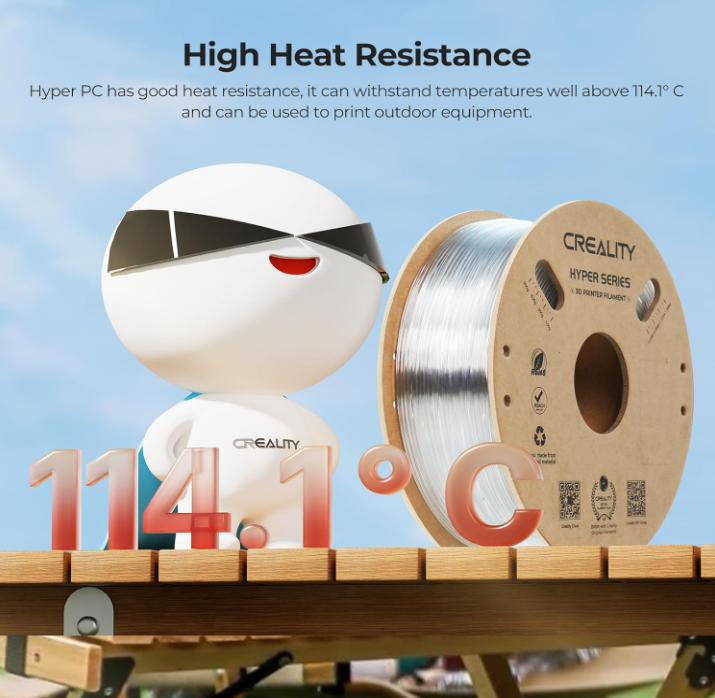
High Heat Resistance
Hyper PC is designed for applications requiring better temperature performance than common PLA.
This makes it useful for:
- Equipment components
- Machine parts
- Electronics enclosures
- Automotive prototypes
- Workshop components
- Functional engineering parts
For parts that may experience elevated temperatures during use, PC can be a much more appropriate choice than standard PLA.
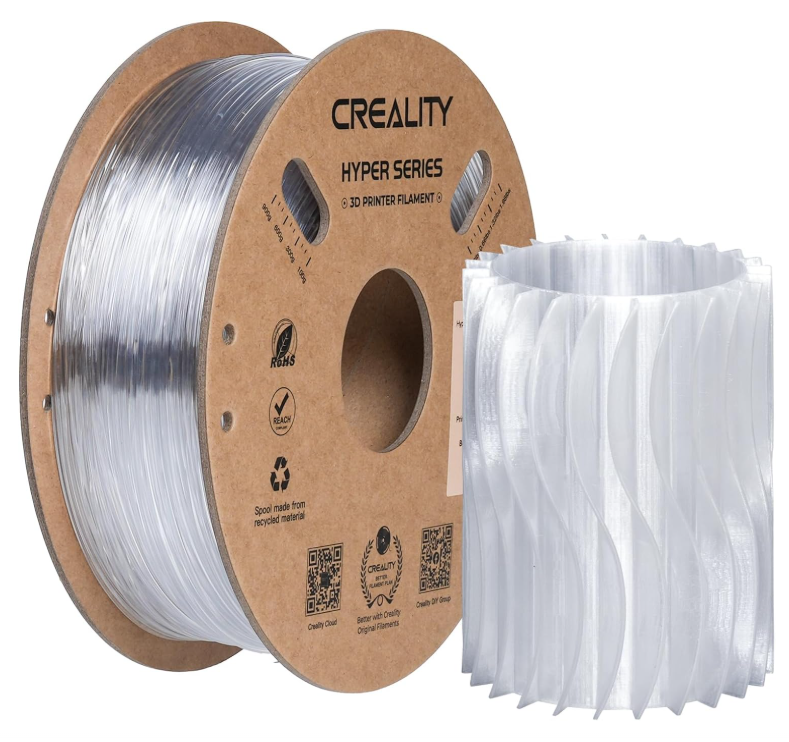
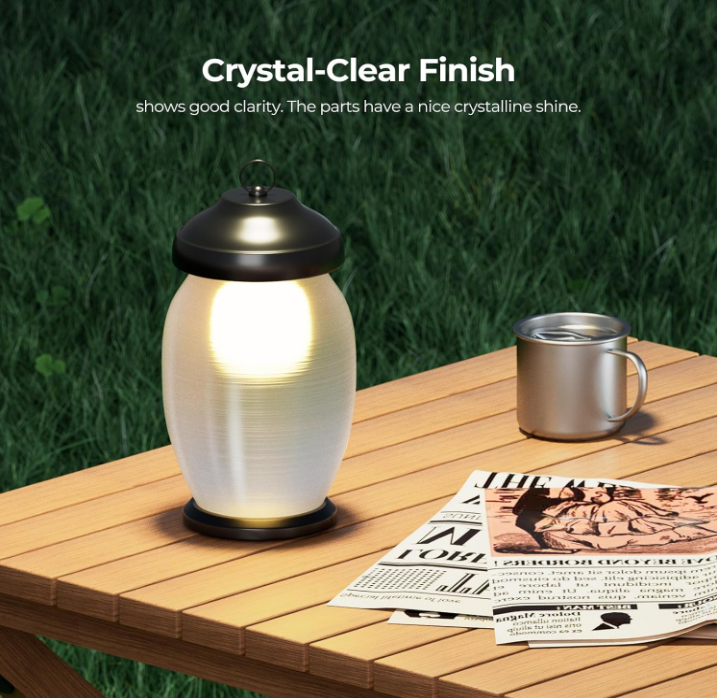
Transparent Appearance
The transparent formulation gives Hyper PC another useful advantage.
It can be used for applications such as:
- Protective covers
- Electronics housings
- Light-transmitting components
- Inspection covers
- Prototype lenses or diffusers
- Display components
- Transparent engineering prototypes
Important Note About Transparency
A 3D printed part will generally not appear perfectly glass-clear straight from the printer.
Layer lines, internal walls, infill and surface texture scatter light. The final level of transparency will depend heavily on:
- Wall thickness
- Layer height
- Number of walls
- Infill
- Printing temperature
- Extrusion consistency
- Model orientation
- Surface finish
For applications where transparency matters, slicer settings should be optimised specifically for the desired optical result.
Excellent for Functional Prototypes
Hyper PC is particularly useful for prototypes that need to behave more like an engineering component rather than simply demonstrate shape and appearance.
Applications include:
- Product-development prototypes
- Mechanical test parts
- Enclosures
- Housings
- Brackets
- Fixtures
- Structural prototypes
- Equipment components
- Low-volume end-use parts
PC vs PLA
| Feature | Hyper PC | Standard PLA |
|---|---|---|
| Ease of Printing | Advanced | Very Easy |
| Mechanical Strength | Excellent | Good |
| Toughness | Excellent | Moderate |
| Impact Resistance | Excellent | Lower |
| Heat Resistance | High | Low |
| Functional Parts | Excellent | Good |
| Engineering Applications | Excellent | Limited |
| Enclosed Printer Preferred | Yes | No |
PLA remains the easier choice for general everyday printing, while Hyper PC is intended for considerably more demanding functional applications.
PC vs PETG
| Feature | Hyper PC | PETG |
|---|---|---|
| Ease of Printing | More Demanding | Easier |
| Strength | Excellent | Very Good |
| Toughness | Excellent | Very Good |
| Impact Resistance | Excellent | Good |
| Heat Resistance | Higher | Moderate |
| Engineering Applications | Excellent | Very Good |
| Functional Prototypes | Excellent | Excellent |
PETG is an excellent general-purpose functional filament, while PC becomes more attractive when strength and temperature performance are priorities.
Advanced Printing Material
Polycarbonate requires more careful printing conditions than PLA.
For the best results, a printer should ideally provide:
- High-temperature capable hotend
- Heated build plate
- Enclosed build chamber
- Suitable build surface
- Good first-layer adhesion
- Stable ambient printing temperature
An enclosed printer is strongly preferred because maintaining a stable environment helps reduce warping and internal stress.
Keep the Filament Dry
PC is moisture sensitive and should be stored carefully.
Moist filament can result in:
- Popping during extrusion
- Increased stringing
- Rough surfaces
- Reduced transparency
- Inconsistent extrusion
- Poor surface quality
- Reduced mechanical performance
Keep the filament sealed with desiccant when not in use, and dry it before printing if it has absorbed moisture.
For long engineering prints, feeding directly from a suitable filament dryer or dry box is recommended.
Ideal For
Creality Hyper PC is an excellent choice for:
- Engineering components
- Mechanical parts
- Functional prototypes
- Enclosures
- Protective housings
- Structural brackets
- Equipment components
- Machine parts
- Automotive prototypes
- Robotics
- Workshop components
- Replacement parts
- Transparent functional components
- Product-development prototypes
- Low-volume production
Technical Specifications
| Specification | Details |
|---|---|
| Brand | Creality |
| Range | Hyper Series |
| Material | PC (Polycarbonate) |
| Appearance | Transparent |
| Filament Diameter | 1.75mm |
| Net Weight | 1kg |
| Material Category | Engineering Filament |
| Heat Resistant | Yes |
| Impact Resistant | Yes |
| Moisture Sensitive | Yes |
| Dry Storage Recommended | Yes |
| Enclosed Printer Recommended | Yes |
| Printer Technology | FDM / FFF |
| Primary Benefits | Strength, Toughness, Heat & Impact Resistance |
Creality’s current official product listing confirms the Hyper Series PC, Transparent option, 1.75mm format and 1kg spool.
Compatible Printers
Creality Hyper PC should be used with a printer capable of handling engineering-grade polycarbonate.
Suitable printers can include appropriately configured:
- Creality K2 Plus
- Creality K2 Pro
- Creality K1C
- Creality K1 Max
- Other enclosed, high-temperature capable FDM/FFF printers
Always confirm that the specific printer’s hotend, bed and build environment meet the requirements of the material.
Why Choose Creality Hyper PC?
Creality Hyper PC is aimed at users who need significantly more performance than ordinary everyday filament.
Its combination of:
- High strength
- Excellent toughness
- Impact resistance
- Heat resistance
- Transparent appearance
makes it particularly useful for demanding prototypes, enclosures, mechanical parts and engineering components.
It’s a strong step up for customers who have reached the limits of PLA or PETG and need a genuine engineering-grade material


Reviews
There are no reviews yet.